BJJ for Beginners: Your Complete Guide to Starting Brazilian Jiu-Jitsu
What to Expect, Basic Moves You'll Learn & How to Start Without Intimidation
Curious about Brazilian Jiu-Jitsu but intimidated by the thought of walking into a gym? Worried you're not athletic enough, flexible enough, or tough enough to start? Concerned you'll be the only beginner in a room full of experienced grapplers?
Every person training BJJ today started exactly where you are—nervous, uncertain, and questioning whether they could actually do this. This guide removes the mystery from Brazilian Jiu-Jitsu for complete beginners. You'll learn what BJJ actually is, the basic moves everyone starts with, what to expect in your first month, and how to begin without feeling overwhelmed. Whether you're 25 or 55, athletic or completely sedentary, BJJ is more accessible than you think.

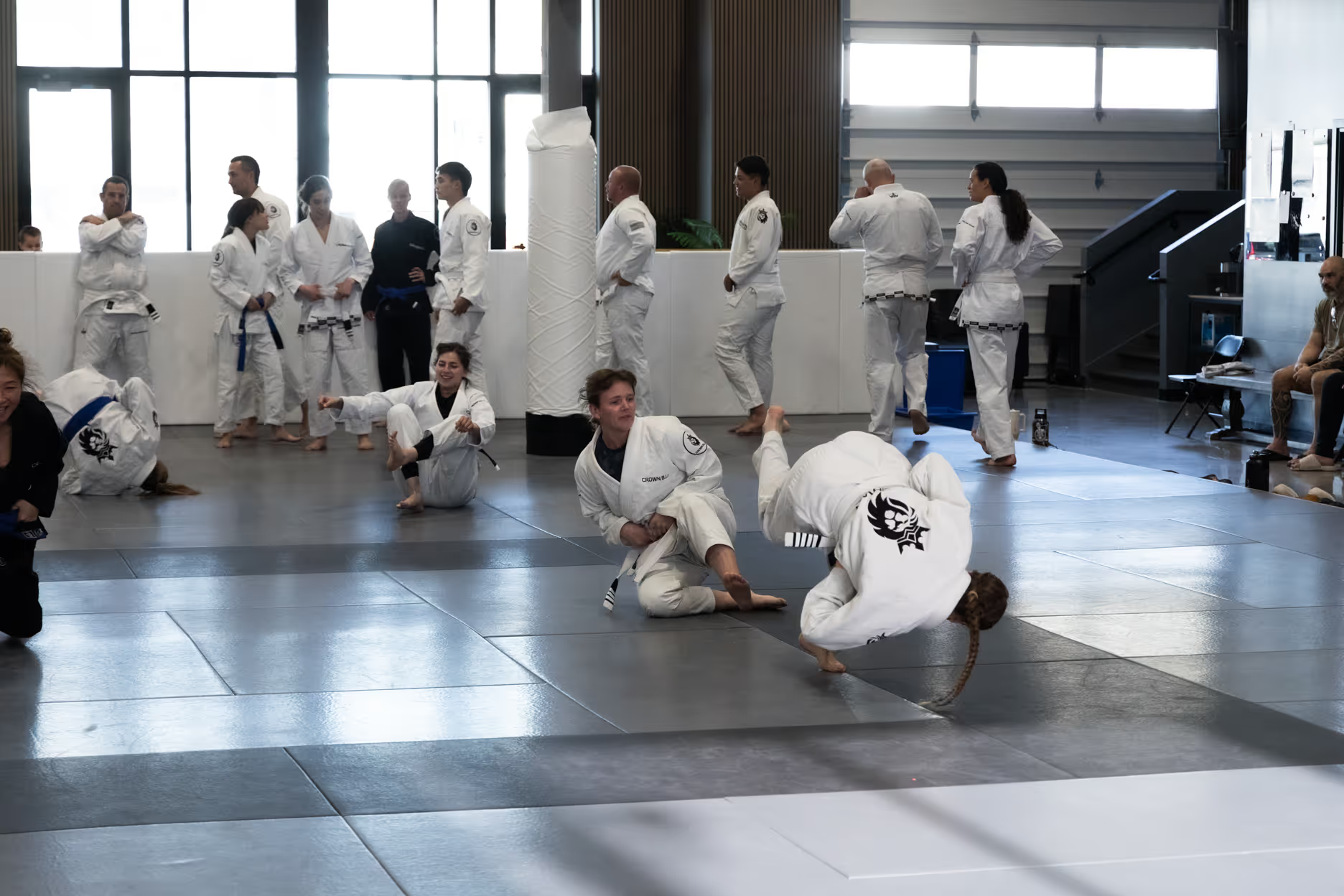
BJJ is the Most Beginner-Friendly Martial Art You've Never Tried
Unlike striking martial arts where beginners absorb punches and kicks while learning, BJJ allows you to train at full intensity safely from day one. Unlike team sports requiring existing athleticism, BJJ accommodates complete beginners regardless of fitness level. Unlike weightlifting or running requiring solo motivation, BJJ provides built-in community accountability and measurable progress through belt ranks.
Most importantly: Brazilian Jiu-Jitsu is designed around technique over strength. A 150-pound person can control a 220-pound opponent using leverage and positioning—which means your current fitness level doesn't determine whether you can start. It determines how quickly you'll improve your fitness through training.
This guide answers every question beginners actually have (not just the ones gyms want to answer). You'll understand BJJ fundamentals before stepping on the mat, making your first class less intimidating and more productive.
Understanding BJJ for Complete Beginners
Brazilian Jiu-Jitsu is a grappling-based martial art focused on controlling opponents through positions and leverage rather than striking. Here's what that means in practical terms.
.avif)
The Core Concept: Leverage Over Strength
- The Fundamental Principle:
BJJ uses joint locks, chokes, and body positioning to control and submit opponents regardless of size difference. A smaller person can defeat a larger, stronger opponent by using technique correctly.
- Real-World Application:
This makes BJJ one of the most effective self-defense systems for people who can't rely on size or strength. Women learning self-defense, smaller men concerned about street altercations, and anyone wanting practical protection skills find BJJ uniquely valuable.
- How This Works:
Instead of exchanging punches or kicks, BJJ takes the fight to the ground where strength matters less and positioning matters more. On the ground, a 140-pound person who understands leverage can control a 200-pound person who doesn't.
BJJ vs Other Martial Arts
- BJJ vs Karate/Taekwondo:
- Karate/TKD focus on striking (punches, kicks) from standing positions
- BJJ focuses on grappling and ground fighting
- Research shows 70-90% of street altercations end on the ground—where striking arts have limited application but BJJ excels - BJJ vs Boxing/Kickboxing:
- Boxing/kickboxing develop excellent striking skills and cardio
- They don't address what happens when someone tackles you or grabs you
- BJJ specifically trains for close-range grappling situations where strikes are difficult to land - BJJ vs Wrestling:
- Wrestling focuses on takedowns and pinning opponents (keeping them on the ground)
- BJJ includes takedowns but emphasizes submissions (forcing opponents to quit through chokes or joint locks)
- Wrestling matches have time limits; BJJ teaches how to actually finish a confrontation - BJJ vs Judo:
- Judo emphasizes throwing opponents and has ground fighting elements
- BJJ emphasizes ground fighting with throwing as secondary skill
- Judo competitions have restricted ground fighting time; BJJ has no time limit on ground work - Bottom Line for Beginners:
BJJ is the most comprehensive grappling art for self-defense because it focuses on real-world situations (ground fighting) where technique overcomes size and strength.
What Makes BJJ Unique
- Live Sparring ("Rolling") from Day One:
Unlike many martial arts where beginners practice choreographed techniques for months before applying them, BJJ students "roll" (spar) within their first few weeks. This means you're applying techniques against resisting opponents who don't want you to succeed—which forces you to actually learn what works.
- Realistic Training Environment:
You can train BJJ at 100% intensity without injury risk. When someone locks in a submission (choke or joint lock), you "tap" (signal surrender) and they release immediately. This allows full-intensity practice safely.
- Measurable Progress:
Belt ranks provide clear progression from white belt (beginner) through blue, purple, brown, to black belt (typically 10+ years). Each belt represents genuine skill development you can feel during rolling.
- Chess-Like Strategy:
BJJ is often called "physical chess." Every position has multiple responses. Every technique has counters. Beginners initially feel overwhelmed by complexity but soon realize this depth makes training intellectually engaging rather than mindlessly repetitive.
Benefits of BJJ for Beginners (And Who It's Actually For)
BJJ works for a wider range of people than most martial arts. Here's what you'll gain and whether it fits your situation.
Physical Benefits (Even for Non-Athletes)
- Full-Body Fitness Without Gym Boredom:
Each class burns 500-800 calories through grappling that works every muscle group. You'll develop cardiovascular endurance, functional strength, and flexibility—all while learning technique rather than staring at a treadmill.
- Develops Functional Movement:
BJJ teaches your body to move in ways typical gym workouts don't address. Hip mobility, core rotation, and proprioception (knowing where your body is in space) all improve rapidly. This translates to better overall athleticism and injury prevention in daily life.
- Weight Loss Without "Dieting":
Many beginners lose 15-30 pounds in their first year simply through consistent training 3-4 times weekly. The calorie burn is substantial, and the community accountability keeps you showing up even when motivation wanes.
- Builds Strength That Actually Matters:
You'll develop "grappling strength"—the ability to control another person's body weight through leverage and positioning. This is different than gym strength and translates directly to real-world situations.
Mental & Emotional Benefits
- Genuine Confidence (Not Arrogance):
Knowing you can defend yourself against larger opponents creates quiet confidence that affects how you carry yourself daily. This isn't macho posturing—it's calm assurance that changes how others interact with you.
- Stress Relief Through Focus:
BJJ demands complete mental presence. When someone's trying to choke you, you can't think about work stress, relationship problems, or anything except the immediate challenge. This forced focus provides mental reset similar to meditation.
- Problem-Solving Skills:
Every roll is a puzzle to solve. How do I escape this position? Which submission is available? What happens if I move my hip here? This constant problem-solving strengthens cognitive flexibility and strategic thinking.
- Ego Management:
BJJ humbles everyone. You'll get submitted repeatedly by people smaller than you. You'll spend months struggling with techniques that seem simple. Learning to accept failure, adapt, and improve without quitting develops resilience that carries beyond the mats.
Social Benefits
- Built-In Community:
BJJ gyms develop unusually tight-knit communities because you're literally trusting training partners with your physical safety. The people who submit you during rolling often become your closest friends outside the gym.
- Diverse Demographics:
Unlike pickup basketball requiring existing athleticism or CrossFit attracting specific personality types, BJJ accommodates everyone. You'll train alongside doctors, teachers, construction workers, students, retirees—all united by learning the same skill.
- Accountability Through Relationships:
The social bonds make consistency easier. When training partners ask why you missed class, you're more likely to show up next time. This accountability is why BJJ has higher retention than solo fitness activities.
Who BJJ is Actually For
- Complete Beginners with Zero Martial Arts Experience:
The majority of BJJ students started with no combat sports background. Instruction assumes zero knowledge. You'll learn everything from "this is how you stand" to advanced strategy.
- People Who "Aren't Athletic":
You don't need to be athletic to start—training makes you athletic. Several Crown BJJ members began training 50+ pounds overweight or unable to run half a mile. They're now fit, confident, and skilled because they showed up consistently.
- Women Concerned About Training with Men:
BJJ is one of the few martial arts where technique genuinely equalizes size/strength differences enough that women can effectively train with men. Many women prefer co-ed classes because it proves they can actually defend against larger male attackers.
- Older Adults (35-55+):
BJJ accommodates age better than high-impact activities. You can train at your own intensity level, avoid risky positions as needed, and scale rolling difficulty by choosing training partners carefully. Several Crown BJJ members started after age 45.
- Parents Teaching Kids by Example:
Many adults begin BJJ when their children start training—and discover they enjoy it more than expected. Training together creates shared family activity and models healthy lifestyle choices.
- Anyone Wanting Practical Self-Defense:
If your goal is genuine ability to protect yourself against larger attackers, BJJ provides the most realistic training available. You'll regularly practice against fully resisting opponents, developing skills that actually work under pressure.
Fundamental Techniques Every Beginner Learns First
These are the core positions and movements you'll spend your first 3-6 months developing. Don't memorize this list—it's just orientation to what you'll learn.
Basic Positions (What They Are & Why They Matter)
- Guard Position:
- You're on your back with opponent between your legs
- Your legs control their hips/torso
- Defensive position where you prevent being struck or passed
- Beginners learn: closed guard (legs locked around opponent's waist) - Why it matters:
Most self-defense situations end with the aggressor on top of you. Guard position protects you and creates submission opportunities from defensive position.
- Mount Position:
- You're sitting on opponent's chest/stomach, facing them
- Your knees are on the ground on either side of their body
- Dominant position with submission and striking opportunities
- Opponent is in very bad situation if you're mounted on them - Why it matters:
Mount is one of the most controlling positions in BJJ. Achieving mount in your first few months feels like a huge accomplishment.
- Side Control:
- You're perpendicular to opponent who is on their back
- Your chest pressure pins their upper body
- Dominant position with multiple submission options
- Requires using body weight effectively, not just strength - Why it matters:
Side control teaches beginners how to use weight and pressure to control opponents—fundamental skill for all BJJ.
- Back Control:
- You're behind opponent with hooks (legs) controlling their hips
- Your arms can attack their neck for chokes
- Most dominant position in BJJ
- Very difficult for opponent to escape - Why it matters:
Back control provides the highest-percentage submissions. Learning to take and maintain back position is advanced beginner skill.
Fundamental Movements
- Shrimp Escape (Hip Escape):
- Fundamental defensive movement to create space
- Lie on your back, bridge hips up, slide hips away from opponent
- Used constantly to escape bad positions
- First movement every beginner learns - Why it matters:
Shrimping is to BJJ what dribbling is to basketball—the most basic, essential movement you'll use forever.
- Bridge Escape (Upa):
- Explosive hip movement to off-balance opponent in mount
- Trap opponent's arm/leg, bridge hips forcefully, roll them over
- Very satisfying when it works
- Requires timing more than strength - Why it matters:
Demonstrates how technique overcomes size. A 140-pound person can throw off a 200-pound opponent using bridge escape correctly.
- Technical Stand-Up:
- Safe way to return to standing from ground
- Protects against strikes while standing
- Basic self-defense movement
- Develops balance and body awareness - Why it matters:
Real fights don't stay on the ground forever. Knowing how to stand safely is essential self-defense skill.
Basic Submissions (What Beginners Actually Practice)
- Rear-Naked Choke (RNC):
- Choke from back position using forearm against opponent's neck
- High-percentage submission even for beginners
- Works without strength if positioned correctly
- One of the first submissions beginners successfully apply - Armbar:
- Joint lock that hyperextends opponent's elbow
- Can be applied from multiple positions
- Teaches control and patience (forcing it causes escape)
- Feels like magic when you catch someone in it - Triangle Choke:
- Choke using your legs around opponent's neck and arm
- Requires flexibility and positioning
- More advanced beginner technique (month 3-6)
- Very effective for smaller people against larger opponents - Guillotine Choke:
- Front headlock choke using arms
- Often attempted during takedown defense
- Can be done standing or on ground
- Beginners often try this too early and too forcefully (doesn't work that way) - Kimura (Shoulder Lock):
- Shoulder joint lock with various applications
- Versatile from multiple positions
- Teaches grip fighting and control
- Named after Masahiko Kimura who defeated Hélio Gracie using it - Beginner Reality Check:
You'll learn these submissions in your first 3-6 months but won't successfully apply them consistently until month 6-12. That's normal. Everyone sucks at first.
Week-by-Week Expectations for Complete Beginners
Here's what actually happens in your first month training BJJ—not the marketing version, the real version.
Week 1: Overwhelming Confusion (Totally Normal)
- What You'll Learn:
- Basic positions: guard, mount, side control
- Fundamental movement: shrimping (hip escape)
- Simple escapes from bad positions
- How to "tap" (surrender signal) - How You'll Feel:
Completely lost. You won't remember anything 5 minutes after learning it. You'll feel uncoordinated. You'll have no idea what your body is doing. Training partners will easily submit you. This is universal—everyone experiences this.
- What's Actually Happening:
Your brain is processing entirely new movement patterns. Your body doesn't know how to move in ways BJJ requires yet. This confusion means learning is happening, not that you're bad at BJJ.
- Common Week 1 Thoughts:
- "Everyone else seems to know what they're doing except me" (they felt the same way their first week)
- "I'm terrible at this" (everyone is terrible at first)
- "Should I quit?" (no—week 2 is better)
Week 2: Slight Recognition (Progress Begins)
- What You'll Learn:
- More positions and transitions
- Basic takedowns (getting opponent to ground)
- Introduction to "rolling" (light sparring with guidance)
- How to breathe during exertion (you'll forget and gas out quickly) - How You'll Feel:
Still confused but with occasional moments of "oh, I've seen this before." You'll recognize positions even if you don't know what to do from them yet. Your body will be very sore—especially neck, shoulders, and fingers from gripping.
- What's Actually Happening:
Your brain starts creating neural pathways for BJJ movement. You're developing "grappling cardio"—different from running cardio. Your body is adapting to new stress.
- Encouraging Signs:
- You remember one or two technique names
- You successfully escape a bad position once
- You don't feel quite as lost as week 1
Week 3-4: Foundation Building
- What You'll Learn:
- Review and refinement of week 1-2 techniques
- Introduction to basic submissions
- More live rolling with varied partners
- Positional sparring (starting in specific positions) - How You'll Feel:
You'll have breakthrough moments where a technique actually works. You'll also have frustrating sessions where nothing works. This is normal progression—two steps forward, one step back.
- What's Actually Happening:
Your body is building muscle memory for fundamental movements. You're starting to recognize positions during rolling and occasionally execute correct responses. Your cardiovascular system is adapting to grappling demands.
- Month 1 Milestones:
- You successfully escape mount or side control during rolling
- You apply a submission (even if partner lets you)
- You can explain one technique to someone asking about BJJ
- You're not completely exhausted after warm-ups anymore - Month 1 Reality:
You'll still get submitted by everyone. You'll still feel confused often. You'll still question if you're improving. But if you attend 8-12 classes in your first month, you're developing foundational skills that will compound over time.
How to Avoid the Mistakes Every New BJJ Student Makes
These errors are universal. Knowing about them beforehand helps you avoid wasting time.
Using Strength Instead of Technique
- The Mistake:
Trying to muscle your way out of bad positions or force submissions through strength rather than proper positioning.
- Why Beginners Do This:
Using strength feels productive when technique isn't working yet. It's instinctive to push harder when something's not working.
- Why It's Counterproductive:
- You gas out in 2 minutes, making rest of class unproductive
- You never learn proper technique because you compensate with strength
- You're more likely to injure yourself or training partners
- Smaller/weaker people with better technique will still submit you - The Fix:
Focus on positioning and leverage rather than force. If something requires maximum strength, you're doing it wrong. Ask training partners or instructors "what am I missing here?" when technique isn't working.
Not Tapping Early Enough
- The Mistake:
Fighting submissions too long before tapping, risking injury from stubbornness.
- Why Beginners Do This:
Ego. Tapping feels like losing. Beginners want to prove toughness by resisting submissions as long as possible.
- Why It's Counterproductive:
- Joint locks can cause serious injuries if held too long
- Chokes can cause unconsciousness in 3-5 seconds once fully locked
- Refusing to tap doesn't teach you how to escape—it just increases injury risk
- Training partners will avoid rolling with you if you don't tap safely - The Fix:
Tap early and often in training. You're not competing—you're learning. Getting submitted 100 times teaches you to defend submissions. Refusing to tap teaches you nothing except how to get injured.
- Tapping is Not Losing:
In training, tapping means "you got me, let's reset and go again." It's how you accumulate experience safely.
Comparing Yourself to Experienced Students
- The Mistake:
Feeling discouraged because blue belts easily submit you or move in ways you can't replicate.
- Why Beginners Do This:
It's natural to compare yourself to people around you and feel inadequate when you're the least skilled person in the room.
- Why It's Counterproductive:
- You're comparing your day 1 to their year 3+
- This breeds discouragement and quitting
- You miss the point: compare yourself to yesterday-you, not others - The Fix:
Measure progress against your own past performance. Can you hold side control 5 seconds longer than last month? Do you recognize positions you had no awareness of before? Are you less exhausted after class than week 1?
- Reality Check:
That blue belt submitting you easily was exactly where you are now 2-3 years ago. They got better by showing up consistently—not by being naturally talented.
Training Inconsistently
- The Mistake:
The majority of BJJ students started with no combat sports background. Instruction assumes zero knowledge. You'll learn everything from "this is how you stand" to advanced strategy.
- Why Beginners Do This:
Life gets busy. Motivation wanes when progress feels slow. Soreness makes people skip classes.
- Why It's Counterproductive:
- BJJ requires consistency to develop muscle memory
- Training once every two weeks means constantly relearning basics rather than progressing
- The community bonds that provide accountability don't form with inconsistent attendance
- You never get past the "everything is overwhelming" phase - The Fix:
Commit to 2-3 times weekly minimum for first 3 months. Schedule classes like important meetings. Training through soreness (not injury) is how your body adapts.
- Minimum Effective Dose:
2x weekly shows slow but steady progress. 3x weekly is optimal for beginners balancing BJJ with work/life. 4+ times weekly accelerates progress significantly.
Not Asking Questions
- The Mistake:
Struggling silently with technique rather than asking instructors or training partners for clarification.
- Why Beginners Do This:
Don't want to seem stupid or annoying. Assume they should figure things out themselves.
- Why It's Counterproductive:
- You waste weeks doing techniques incorrectly that could be fixed in 30 seconds of instruction
- Instructors want you to ask—that's literally their job
- Training partners remember being confused beginners and are happy to help - The Fix:
Ask specific questions during or after class. "Why doesn't this sweep work when I try it?" is better than "I don't understand sweeps." Specific questions get specific, helpful answers.
Essential Terms Beginners Should Know
You'll hear this vocabulary constantly. Knowing what it means reduces confusion.
- Gi:
The traditional BJJ uniform (jacket and pants). Some classes require gi; others allow no-gi training (t-shirt and shorts).
- Tap/Tapping:
Physical or verbal signal that you surrender (opponent releases immediately). Tap repeatedly on opponent, mat, or yourself, or say "tap."
- Rolling:
Live sparring. BJJ's equivalent of boxing's sparring or soccer's scrimmage.
- Positional Sparring:
Rolling that starts from specific position rather than neutral standing position.
- Submission:
Technique that forces opponent to tap through choke or joint lock.
- Sweep:
Technique that reverses position (you're on bottom, then on top).
- Pass/Passing:
Moving past opponent's guard (legs) to achieve dominant position.
- Guard:
Position where you're on your back using legs to control opponent.
- Mount:
Position where you're sitting on opponent's chest/stomach.
- Side Control:
Position where you're perpendicular to opponent, pinning their upper body.
- Back Control:
Position where you're behind opponent with hooks controlling their hips.
- Base:
Your stability and balance. "Losing your base" means getting off-balanced.
- Posture:
Maintaining upright positioning to defend submissions and passes.
- Pressure:
Using body weight effectively to control opponent or prevent movement.
- Frame:
Using arms/legs to create space between you and opponent.
- Grip/Grip Fighting:
Controlling opponent's gi fabric or wrists; battling for favorable grips.
- Open Mat:
Unstructured training time where students roll without formal instruction.
- Drilling:
Practicing techniques repeatedly on compliant partner to develop muscle memory.
- Flow Rolling:
Light-intensity rolling focused on movement and positioning rather than submission hunting.
What Makes Crown BJJ Specifically Beginner-Friendly
Many gyms claim to be beginner-friendly. Here's what Crown BJJ actually does differently for new students.
Dedicated Fundamentals Program
- Structured for Zero Experience:
Our fundamentals classes assume you've never done martial arts. Instruction starts from "this is a basic stance" and builds systematically. You're not thrown into mixed-level classes and expected to keep up.
- Curriculum Designed for Adults:
Adults learn differently than kids. We teach concepts and principles, not just "do this move." Understanding why techniques work helps adults retain information better.
- Consistent Review Cycle:
Fundamental positions and movements are reviewed every 4-6 weeks. This repetition ensures beginners build solid foundation rather than learning 100 techniques poorly.
- Progress Tracking:
We track which techniques you've been exposed to and which need more work. This personalized attention ensures gaps in your knowledge get addressed.
Small Class Sizes & Individual Attention
- 15-18 Students Maximum:
We cap fundamentals classes to ensure instructors have time for individual technique correction. Large classes (25-30 students) make personalized instruction impossible.
- Assistant Coaches for Beginners:
Advanced students and assistant instructors circulate during drilling to provide real-time feedback. You're not waiting until end of class to get technique corrections.
- Question-Friendly Culture:
We encourage questions during and after class. Instructors explicitly tell new students "stop me if anything is confusing" rather than assuming everyone understands.
- Private Lesson Options:
For students wanting additional personalized attention, our world-champion trained instructors offer private lessons at reasonable rates.
Ego-Free Training Environment
- No Tough-Guy Culture:
Some BJJ gyms cultivate aggressive, competitive atmosphere where beginners feel intimidated. Crown BJJ intentionally builds welcoming culture where helping beginners is valued.
- Controlled Rolling Intensity:
Instructors manage who rolls with whom, especially for first-time rollers. New students aren't randomly thrown with aggressive advanced students who smash them.
- Size/Skill Matching:
We pair beginners with similar-sized training partners when possible and with patient advanced students who focus on teaching rather than dominating.
- No Pressure to Compete:
Competition is encouraged for interested students but never required. Many members train for fitness, self-defense, or personal challenge without competitive goals.
World-Champion Instruction Explains "Why"
- High-Level Teaching Methodology:
Our head instructor earned his black belt under a Worlds gold medalist. High-level practitioners understand nuances that lesser-ranked instructors miss—and can explain techniques more clearly.
- Concept-Based Teaching:
Instead of just demonstrating moves, we explain underlying principles. Understanding concepts helps beginners apply techniques in varied situations rather than memorizing rigid sequences.
- Common Beginner Mistakes Anticipated:
Experienced instructors know exactly where beginners struggle and proactively address these issues. "Everyone tries to use strength here—don't. Here's why and what to do instead."
Family-Focused Community
- Parents Train During Kids' Classes:
If your children are in kids BJJ, you can train simultaneously in adult class. This makes scheduling sustainable for families.
- Social Events Beyond Training:
Crown BJJ hosts family-friendly events, birthday parties, and open mats where members socialize outside regular class structure. This community bonds accelerate the "I belong here" feeling that keeps beginners consistent.
- Long-Term Member Retention:
Our average member has trained 2+ years. Beginners benefit from experienced students who remember being new and actively help newcomers integrate.
Common Beginner Questions Answered
No. Fitness is the result of training, not a prerequisite. BJJ will get you in shape—you don't need to be in shape to start. Several Crown BJJ members began training 40-50 pounds overweight or unable to run a mile. They're now fit because they showed up consistently.
Minor bumps, bruises, and soreness are normal. Serious injuries are rare when training with control and tapping appropriately. BJJ is safer than most contact sports because submissions allow you to surrender before injury occurs.
Several Crown BJJ members started training after age 40-50. BJJ accommodates age better than high-impact sports because you control intensity by choosing training partners and can avoid risky positions. You won't progress as fast as 20-year-olds but you'll absolutely develop real skills.
You'll develop flexibility through training. BJJ requires less flexibility than you think—it's more about technique and positioning than splits and high kicks. Your flexibility will improve naturally through consistent practice.
Typically 1.5-3 years of consistent training (3-4 times weekly). This varies based on athleticism, prior experience, and training consistency. Focus on learning rather than chasing belts—they come with skill development.
Athletic clothes: t-shirt and shorts or athletic pants. No shoes on the mat. No pockets, zippers, or metal that could catch on training partners. We'll provide a loaner gi if needed for gi classes.
No. Instructors match beginners with appropriate training partners. Experienced students know how to roll with new people safely—helping you learn rather than dominating you. If anyone trains too aggressively, instructors address it immediately.
Yes. BJJ is among the most effective martial arts for real-world self-defense because you train against fully resisting opponents. The skills work under pressure because you've practiced them under pressure. Most self-defense situations end in grappling range where BJJ excels.
Start Brazilian Jiu-Jitsu at Crown BJJ Bluffdale
You understand what BJJ is, what beginners learn, and what to expect in your first month. The remaining question is when you'll actually start.
Crown BJJ's fundamentals program is specifically designed for complete beginners—adults who've never done martial arts, people concerned about fitness level, anyone intimidated by the idea of combat sports training. You'll learn from world-champion trained instructors in small classes (15-18 students max) with personalized attention that large gyms can't provide.
Our beginner-friendly culture, ego-free training environment, and proven instruction methodology have helped hundreds of complete beginners develop legitimate BJJ skills. Several current advanced students started training here as overweight, out-of-shape beginners who'd never done athletics. They're now fit, confident, skilled grapplers because they showed up consistently—not because they were naturally talented.
Book your free trial class today. Experience our fundamentals instruction, meet our coaches, talk with current members who were exactly where you are now. No pressure, no obligation, no intimidation—just honest training from people who remember being confused beginners.
.webp)

Crown BJJ Bluffdale - Fundamentals Program
Beginner-friendly instruction | Small class sizes (15-18 max) | World-champion trained coaches
No experience required | All fitness levels welcome | Free trial class available
Questions about starting as a complete beginner? Text/call us at [phone] or email [email]




.webp)
.webp)
.webp)