Why Brazilian Jiu-Jitsu is the Most Effective Self-Defense
The Science and Statistics Behind BJJ's Real-World Effectiveness
Researching self-defense options and overwhelmed by conflicting claims? Krav Maga instructors say their system is "most realistic." Karate schools promise effective self-defense. Weekend seminars claim you can learn to defend yourself in 8 hours. BJJ gyms (including this one) say Brazilian Jiu-Jitsu works best.
Who's actually right?
This guide uses statistics, research data, and honest analysis to explain why Brazilian Jiu-Jitsu is the most effective self-defense system for most people—particularly those who can't rely on size, strength, or athletic ability. You'll understand the fundamental problems with traditional self-defense methods, why BJJ solves those problems, how BJJ compares to other martial arts for real-world situations, and which Crown BJJ programs teach practical self-defense skills.
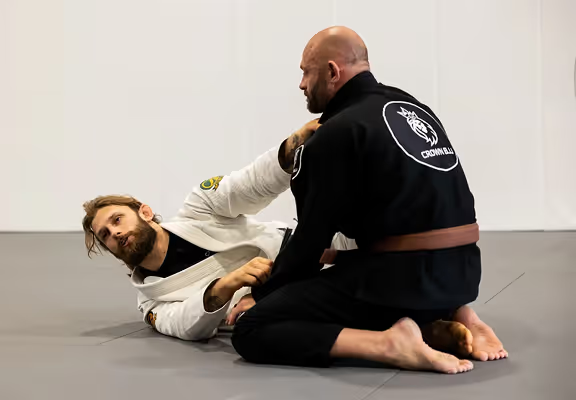
Why This Analysis Matters: Choosing Effective Self-Defense
Most self-defense marketing relies on fear and unverifiable claims. "Our system is used by special forces!" "Learn to defeat any attacker!" "Become a deadly weapon in 6 weeks!"
These claims are difficult to evaluate objectively because actual self-defense situations are rare, unpredictable, and rarely documented. You can't run controlled experiments on violent attacks.
However, we can evaluate self-defense systems using these objective criteria:
- **Training methodology:** Does the system practice against fully resisting opponents or compliant partners?
- **Physical principles:** Does effectiveness depend on size/strength or leverage/technique?
- **Skill retention:** Can students maintain skills without constant practice, or does muscle memory require ongoing training?
- **Statistical evidence:** What percentage of real altercations occur in ranges where this system applies?
- **Competitive validation:** Do practitioners regularly test skills against non-cooperative opponents?
Brazilian Jiu-Jitsu performs exceptionally well across all these criteria. This isn't marketing—it's analysis based on how BJJ is actually practiced compared to other systems.
Why Most Self-Defense Training Doesn't Work in Real Situations
Traditional self-defense classes—the weekend seminars, 6-week courses, and "women's safety" workshops—have fundamental flaws that prevent students from developing usable skills.
.avif)
Choreographed Techniques Against Compliant Partners
- What Traditional Self-Defense Teaches:
Instructor demonstrates defense against specific attack. Student practices technique on cooperative partner who attacks exactly as demonstrated. Student never practices against someone actively trying to defeat their defense.
- Example:
"If someone grabs your wrist like this, rotate your hand this way and pull away." Partner grabs wrist gently, student rotates hand, partner releases as expected.
- The Problem:
Real attackers don't grab your wrist politely and release when you rotate your hand. They grip hard, adjust their position when you resist, and don't cooperate with your escape attempt.
- Why This Fails:
Students develop false confidence from techniques that work only when partners cooperate. Under actual stress against non-cooperative opponents, these techniques fail completely because they were never tested against resistance.
- BJJ's Difference:
BJJ students practice techniques against fully resisting opponents who actively try to prevent your technique from working. If your escape doesn't work against your training partner, you know immediately and adjust. This resistance-based training develops skills that actually function under pressure.
No Accounting for Adrenaline, Fear & Stress Response
- The Biological Reality:
During actual violent confrontation, your body experiences adrenaline dump: heart rate spikes to 175+ BPM, fine motor skills deteriorate, tunnel vision occurs, cognitive processing slows, and you may experience auditory exclusion.
- What Traditional Self-Defense Ignores:
Techniques practiced in calm seminar environment with cooperative partners don't account for how your body responds under actual threat. The complex joint lock you learned in class becomes impossible to execute when your hands are shaking and you can't think clearly.
- Why This Fails:
The gap between seminar practice (calm, cooperative) and real situation (terrified, non-cooperative) is massive. Students freeze, forget techniques, or attempt complex movements they haven't practiced under stress.
- BJJ's Difference:
Rolling (sparring) in BJJ creates physiological stress response—elevated heart rate, heavy breathing, physical exhaustion, and mental pressure from opponent actively trying to submit you. You practice techniques repeatedly while physically and mentally stressed, developing ability to function under pressure. This stress inoculation transfers to real situations.
Weekend Seminar vs Ongoing Skill Development
- Traditional Self-Defense Model:
Attend 4-hour workshop or 6-week course. Learn techniques once or twice. Assume you'll remember them months or years later when needed.
- The Retention Problem:
Motor skills require repetition for retention. A technique practiced 5-10 times in a seminar is forgotten within weeks. Under stress, you won't remember movements you barely practiced in calm environment.
- Research Data:
Studies on skill retention show physical techniques require 100+ repetitions for basic muscle memory and 1,000+ repetitions for stress-resistant automaticity. Weekend seminars provide maybe 10-20 reps per technique.
- Why This Fails:
Self-defense situations happen unpredictably years after training. Without ongoing practice, techniques are forgotten or executed incorrectly when needed most.
- BJJ's Difference:
BJJ is ongoing training, not one-time course. Students practice fundamental escapes, positions, and submissions hundreds of times over months and years. This repetition creates genuine muscle memory that persists even under extreme stress. A BJJ blue belt (1.5-3 years training) has practiced basic escapes literally thousands of times.
No Live Sparring = No Realistic Application
- Traditional Self-Defense Testing:
You practice technique on cooperative partner. Maybe demonstrate it at end of seminar. Never apply it against someone actively resisting.
- The Critical Flaw:
You cannot know if techniques work without testing them against non-cooperative opponents. Compliant partner drills prove nothing about real-world effectiveness.
- Combat Sports Comparison:
Boxers spar. Wrestlers compete. Judoka randori. Every legitimate combat sport includes live practice against resisting opponents because that's the only way to develop functional skills.
- Why Traditional Self-Defense Skips This:
Live resistance exposes technique failure. If students immediately discover their learned techniques don't work against real resistance, they won't sign up for more classes. Economic incentives favor choreographed demonstrations over honest skill testing.
- BJJ's Difference:
BJJ requires live rolling (sparring) from early training. Beginners roll within first few weeks, experiencing what techniques actually work when opponent resists. This immediate feedback loop ensures students develop functional skills rather than false confidence.
Four Reasons Brazilian Jiu-Jitsu is Effective for Real Self-Defense
BJJ addresses every flaw in traditional self-defense through training methodology and technical approach.
Most Real Fights Go to the Ground
- The Statistical Reality:
FBI and law enforcement data consistently shows 70-90% of street altercations end on the ground. Whether through tackling, tripping, or losing balance during grappling exchange, fights rarely stay standing.
- Why This Matters:
If you train only striking (boxing, karate, kickboxing), you're preparing for the 10-30% of situations that stay standing. If attacker tackles you or you trip during confrontation, your striking skills become irrelevant.
- BJJ's Specific Advantage:
Brazilian Jiu-Jitsu was designed for ground fighting. The guard position (defending from your back), mount escapes, and submission from bottom positions are exactly what you need when someone tackles you or pins you down.
- Real-World Application:
- Someone tackles you → You know how to control them from guard position and create escape opportunities
- Someone pins you down → You know specific escapes (shrimp, bridge, technical standup)
- You're underneath larger opponent → You can control distance, prevent strikes, and create submission opportunities - Other Martial Arts Gap:
Karate, Taekwondo, Muay Thai, and boxing don't extensively train ground positions. Once fight hits ground, practitioners of striking arts have limited options. BJJ practitioners are most dangerous on the ground where most fights end.
Leverage Overcomes Size and Strength
- The Fundamental Principle:
BJJ techniques use leverage, positioning, and body mechanics to control opponents rather than requiring superior strength or size.
- Why This Matters:
Most people considering self-defense training are smaller/weaker than potential attackers. If your self-defense requires being stronger than your attacker, it won't work when you actually need it.
- Specific Examples:Hip Escape (Shrimp):
Fundamental movement that creates space between you and heavier opponent on top of you. Uses hip movement and frame creation—not strength—to create escape opportunity.
- Triangle Choke from Guard:
You're on your back, opponent is on top. Using only your legs around their neck and arm, you can render a 200-pound opponent unconscious in 5-8 seconds regardless of your upper body strength.
- Arm Lock (Armbar):
Uses entire body weight and hip leverage against opponent's single arm. A 130-pound person can break a 220-pound person's elbow using proper positioning.
- Scientific Validation:*
BJJ's effectiveness for smaller people has been validated repeatedly through mixed martial arts competitions where 170-pound BJJ practitioners successfully submit 220+ pound opponents with limited grappling experience.
Tested Daily Against Resisting Opponents
- BJJ Training Reality:
Students roll (spar) multiple times weekly against partners who are actively trying to submit them. Every technique is tested under resistance every training session.
- The Feedback Loop:
If your escape doesn't work, you're still stuck under opponent. If your submission attempt fails, opponent capitalizes on your mistake. This immediate feedback forces technique refinement.
- Comparison to Traditional Self-Defense:
- Traditional method: "This technique works" → Hope it does when needed
- BJJ method: "This technique works because I successfully used it against resisting opponent yesterday" - Competitive Validation:
BJJ competitions occur weekly across all levels. Students regularly test techniques against non-cooperative opponents who actively try to defeat them. This competitive validation doesn't exist in traditional self-defense seminars.
- Real Consequence:
BJJ practitioners have genuine, tested ability to control resisting opponents. Traditional self-defense students have hope their techniques might work.
Muscle Memory Through Thousands of Repetitions
- The Retention Requirement:
Under extreme stress (actual violent confrontation), your conscious mind shuts down. You can only execute movements your body knows through deep muscle memory.
- BJJ's Repetition Advantage:
Fundamental escapes, positions, and submissions are practiced hundreds of times over months. After 6 months of consistent BJJ training, you've performed basic hip escapes (shrimping) literally 500+ times.
- Stress-Resistant Skills:
This repetition creates automaticity—ability to execute techniques without conscious thought. When adrenaline spikes and cognitive function degrades, your body remembers hip escape, bridge, or technical standup because you've done them a thousand times.
- Real-World Transfer:
Multiple documented cases exist of BJJ practitioners successfully defending themselves despite having no prior self-defense experience beyond sport BJJ training. The techniques transferred because they were practiced so extensively under realistic resistance.
How BJJ Compares to Other Self-Defense Systems
Every martial art claims self-defense effectiveness. Here's honest comparison based on training methodology and applicable scenarios.
BJJ vs Krav Maga
- Krav Maga's Approach:
Israeli military system emphasizing practical, aggressive defense against common attacks (grabs, chokes, weapon threats). Techniques designed for quick neutralization.
- Strengths:
- Addresses multiple attackers and weapon scenarios
- Emphasizes awareness and de-escalation
- Teaches groin strikes, eye gouges, and tactics BJJ forbids in sport context - Limitations:
- Most Krav Maga schools don't include full-contact sparring (too dangerous)
- Techniques practiced on compliant partners, not resisting opponents
- Effectiveness difficult to validate without competition or sparring
- Skill retention questionable without ongoing practice - BJJ's Advantages:
- Every technique tested against full resistance regularly
- Competitive validation through tournaments
- Skills develop through actual application, not theoretical practice
- Muscle memory from thousands of repetitions - Honest Assessment:
Krav Maga addresses scenarios BJJ doesn't (weapon defense, multiple attackers). BJJ develops deeper skill in unarmed grappling situations through resistance training. Ideal combination: BJJ for foundational grappling skill, Krav Maga concepts for weapon/multiple attacker awareness.
BJJ vs Karate/Taekwondo
- Karate/TKD Approach:
Traditional striking arts emphasizing punches, kicks, and kata (forms). Self-defense application taught through prearranged techniques.
- Strengths:
- Develops kicking and punching power
- Good for fitness and discipline
- Distance management from striking range - Limitations:
- 70-90% of fights go to ground where striking becomes ineffective
- Most schools practice kata and point sparring, not full-contact
- Self-defense techniques are often choreographed, not resistance-tested
- Size/strength matters significantly in striking exchanges - BJJ's Advantages:
- Specifically designed for ground fighting where most altercations end
- Technique over strength/size
- Full-resistance training every session
- Submissions end fights without striking damage - Honest Assessment:
Karate/TKD are excellent martial arts for fitness, discipline, and striking fundamentals. For pure self-defense against larger opponents, BJJ's ground-fighting focus and leverage-based techniques provide more reliable options for average people.
BJJ vs Boxing/Kickboxing
- Boxing/Kickboxing Approach:
Combat sports emphasizing punches (boxing) or punches and kicks (kickboxing) with full-contact sparring.
- Strengths:
- Highly effective striking skills
- Regular live sparring develops functional ability
- Footwork, distance management, and timing under pressure
- Competitive validation through boxing/kickboxing matches - Limitations:
- Requires athleticism, speed, and power to be effective
- No ground fighting component (main gap)
- Size and reach matter significantly
- Striking exchanges risk injury to both parties - BJJ's Advantages:
- Ground fighting coverage where boxing/kickboxing stop
- Technique works regardless of size/reach disadvantages
- Can control opponent without striking (important for women defending against known attackers)
- Submissions end confrontations without punching someone - Honest Assessment:
Boxing and kickboxing are legitimate combat sports that develop real fighting skills. Combined with BJJ, they create comprehensive self-defense ability (striking + grappling). For pure self-defense, BJJ addresses more common scenarios (ground fighting, size disadvantage) than striking alone.
BJJ vs Wrestling
- Wrestling Approach:
Grappling art emphasizing takedowns, control, and pinning opponents.
- Strengths:
- Excellent takedowns and positional control
- High-intensity training creates toughness
- Very effective for controlling opponents
- Competitive validation through wrestling matches - Limitations:
- Limited submission training (wrestling ends with pin, not submission)
- No training from defensive positions (guard work)
- Time limits in competition don't reflect real altercations - BJJ's Advantages:
- Extensive submission arsenal (chokes, joint locks)
- Training from defensive positions (what to do when underneath opponent)
- No time limits—learn to finish confrontations, not just stall
- More complete grappling system for self-defense - Honest Assessment:
Wrestling and BJJ are complementary. Wrestlers have superior takedowns; BJJ practitioners have superior submissions and ground defense. Combined background is ideal. For pure self-defense, BJJ's submission and defensive position training provides more finishing options.
Data Supporting BJJ's Self-Defense Effectiveness
Statistics and research on actual self-defense scenarios validate BJJ's practical approach.
Ground Fighting Statistics
- Law Enforcement Data:
- LAPD study: 62% of altercations ended on ground
- FBI training data: 73% of officer assaults involved ground fighting
- Brazilian police research: 90% of street fights ended with both parties on ground - Why These Numbers Matter:
If 70-90% of real confrontations end on ground, training that doesn't address ground fighting leaves you unprepared for most likely scenario.
- BJJ's Relevance:
Brazilian Jiu-Jitsu specifically trains for ground fighting situations. Every position, escape, and submission assumes you might be underneath larger opponent—exactly where most people end up in real altercations.
Size and Strength Neutralization
- MMA Historical Validation:
Early UFC tournaments (1993-1995) provided closest real-world testing of martial arts effectiveness. Royce Gracie (170 lbs BJJ black belt) defeated opponents weighing 200-260 pounds using BJJ techniques.
- What This Proved:
- Grappling overcomes striking when size disadvantage exists
- Leverage-based techniques work against larger, stronger opponents
- Ground fighting expertise defeats striking expertise in most scenarios - Modern Validation:
Contemporary MMA shows all successful fighters train BJJ regardless of striking background. No fighter can compete without grappling defense because ground fighting is inevitable.
- Self-Defense Application:
If 170-pound BJJ practitioner can submit 250-pound opponent with no grappling training, average person with BJJ training can defend against larger attacker lacking grappling experience.
Stress Response and Technique Retention
- Cognitive Performance Under Stress:
Research shows heart rate above 175 BPM causes:
- Fine motor skill deterioration (70-80% decline)
- Complex decision-making impairment
- Tunnel vision and auditory exclusion
- Reversion to most-practiced responses - Implications for Self-Defense:
Complex techniques practiced few times in seminars won't transfer to high-stress situations. Only deeply ingrained movements through extensive repetition remain accessible under extreme stress.
- BJJ's Training Advantage:
Rolling creates physiological stress response (heart rate 150-180 BPM, exhaustion, mental pressure). Practicing techniques repeatedly under this stress develops stress-resistant skills.
- Validation:
Law enforcement and military increasingly incorporate BJJ into defensive tactics training specifically because resistance-based practice creates stress inoculation that seminar training cannot provide.
How to Learn Effective Self-Defense at Crown BJJ Bluffdale
Crown BJJ offers multiple programs teaching practical self-defense through different approaches.
Women's Self-Defense Program
- Focus:
Practical safety scenarios, awareness, and escape tactics specifically for women.
- What You Learn:
- Awareness and prevention (avoiding dangerous situations)
- Defending common attacks (grabs, chokes, ground pins)
- Escape-focused techniques rather than prolonged fighting
- Stress management and de-escalation - Who It's For:
- Women prioritizing safety and practical defense over sport training
- Those wanting focused self-defense instruction without long-term BJJ commitment
- Anyone concerned about specific scenarios (parking lots, home invasion, dating situations) - Training Format:
Structured program with scenario-based practice, realistic simulation (controlled), and women-only or women-focused environment.
- Time Commitment:
Can learn essential skills in focused program (8-12 weeks), then maintain through occasional practice.

Adult Brazilian Jiu-Jitsu (Sport Training with Self-Defense Application)
- Focus:
Comprehensive BJJ skill development including self-defense application.
- What You Learn:
- Complete ground fighting system (positions, escapes, submissions)
- Defense from bottom positions (guard work)
- Controlling larger opponents through leverage
- Live sparring against fully resisting partners - Who It's For:
- Those wanting deepest self-defense skill through ongoing training
- People interested in BJJ as sport/fitness with self-defense benefit
- Anyone willing to commit to long-term skill development (years) - Training Format:
Regular classes 2-4x weekly with technique instruction, drilling, and live rolling. Belt progression provides clear skill development path.
- Time Commitment:
Long-term journey (years to develop advanced skills), but basic defensive competence develops within 6-12 months of consistent training.
Corporate Self-Defense
- Focus:
Professional self-defense training for workplace teams and organizations.
- What You Learn:
- Situational awareness in professional contexts
- De-escalation and verbal defense
- Physical defense basics for workplace safety
- Team-building through shared training - Who It's For:
- Companies prioritizing employee safety
- Professional organizations in client-facing industries
- Teams wanting shared skill development experience - Training Format:
Customized programs delivered at your workplace or at Crown BJJ facility. Can be one-time workshop or ongoing training series.
Which Program is Right for You?
- Choose Women's Self-Defense if:
- Primary goal is practical safety awareness and escape tactics
- Want focused program without long-term ongoing commitment
- Prefer women-only or women-focused training environment
- Need essential skills quickly (weeks/months vs years) - Choose Adult BJJ if:
- Want deepest possible self-defense skill development
- Interested in BJJ as sport, fitness, and empowerment beyond just defense
- Willing to commit to long-term skill development
- Want competitive validation of skills through tournaments (optional) - Choose Corporate Self-Defense if:
- Seeking training for professional team or organization
- Want customized program addressing workplace scenarios
- Interested in team-building with practical safety component - Can you do multiple?
Absolutely. Several women train sport BJJ for fitness/skill while also attending self-defense focused sessions for scenario-specific preparation.
Common Self-Defense Questions Answered
BJJ is highly effective for self-defense. The sport techniques (guard positions, escapes, submissions) are the same skills needed in ground-fighting self-defense scenarios. While sport BJJ has rules (no striking, no eye gouges), the fundamental ability to control and submit resisting opponents transfers directly to self-defense.
Basic defensive competence—ability to escape from underneath larger opponent, defend chokes, and avoid being controlled—develops in 6-12 months of consistent training (2-3x weekly). Advanced proficiency takes years, but essential self-defense skills develop relatively quickly.
BJJ and Krav Maga serve different purposes. Krav Maga addresses scenarios BJJ doesn't (weapons, multiple attackers). BJJ develops deeper skill through resistance training that Krav Maga typically lacks. For unarmed self-defense against single attacker, BJJ's tested techniques provide more reliable skills than Krav Maga's choreographed responses.
Yes. BJJ was specifically designed to allow smaller, weaker individuals to defend against larger, stronger attackers using leverage. Many women successfully use BJJ in self-defense because techniques don't depend on strength. However, size difference matters—realistic training against larger male partners is essential.
No. Competition is optional. However, occasional competition provides valuable experience applying skills under pressure against non-cooperative opponents—closest simulation to self-defense scenarios. Many students develop excellent self-defense skills through regular training without ever competing.
Both matter. However, since 70-90% of fights end on ground where striking is limited, grappling provides broader self-defense foundation. Ideal self-defense combines striking awareness (boxing/kickboxing) with grappling expertise (BJJ/wrestling). If choosing one, BJJ addresses more common self-defense scenarios.
Try Women's BJJ Free at Crown BJJ Bluffdale
You understand why BJJ works when traditional self-defense fails. You know the statistics supporting ground fighting importance. You've seen how BJJ compares to other martial arts for practical self-defense.
The question is whether you're ready to develop genuine self-defense skills through resistance-tested training rather than hoping choreographed techniques might work when needed.
Crown BJJ offers three approaches to learning self-defense:
- Women's Self-Defense: Focused program for practical safety scenarios
- Adult BJJ: Comprehensive skill development through ongoing sport training
- Corporate Self-Defense: Customized workplace safety training
Choose the approach that fits your goals, schedule, and learning preferences. All three options provide more realistic self-defense preparation than weekend seminars promising quick fixes.
Book your free trial or contact us to discuss which program best addresses your specific self-defense goals.
Explore Self-Defense Programs
%201.avif)

Crown BJJ Self-Defense Training
Women's Self-Defense | Adult BJJ | Corporate Programs
Evidence-based training | Resistance-tested techniques | Practical skills
Questions about self-defense training?
Text/call us at 801-251-6375 or email info@crownbjj.com




.webp)
.webp)
.webp)